WHAT CAN YOU DO WITH WHAT YOU LEARN?
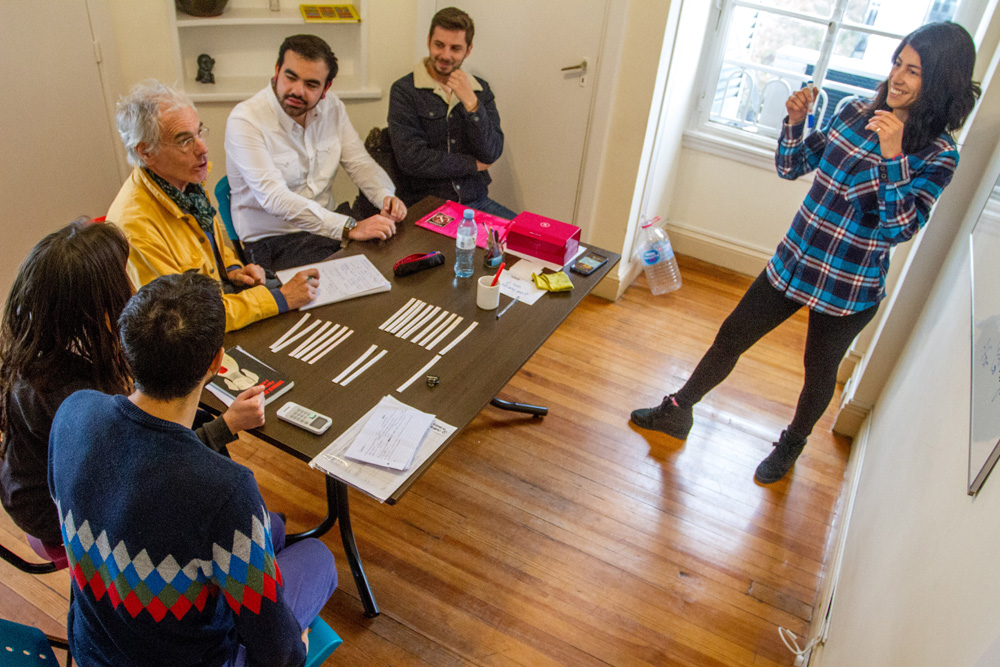
To use it. It’s really that simple. The approach we use in our classes and the one that guides every learning plan we design is the communicative approach.
For certain groups, we also incorporate task-based learning, which can be seen as a more specific version of the communicative approach. It’s particularly effective in longer programs where students work toward a final project or real-world goal. In both cases, the focus is the same: language is not something to be memorized for a test, but a tool to communicate, create, solve problems, and connect with others.
And What Does That Mean in Practice?
It means that the focus of every class is a communicative function. In other words, by the end of the lesson, you’ll be able to do something with the language. Not just repeat a rule or understand a grammatical structure, but actually use Spanish in a real-life context.
For example:
✅ Make an invitation, decline one, and suggest an alternative.
✅ Express likes, dislikes, and preferences.
✅ Give excuses and explanations.
✅ Ask for and give directions.
✅ Handle a job interview.
✅ Compare places.
✅ Take part in an Argentine asado.
And that’s just the beginning.
Yes, ladies and gentlemen, we really do have a huge collection of lesson plans built around practical communicative goals. We won’t list them all here but if you’re curious, feel free to get in touch and ask us. 😉
How Do We Work on This in Class?
Each communicative function comes with its own pedagogical toolkit:
✅ Specific vocabulary.
✅ Useful expressions and common phrases.
✅ Cultural and sociocultural insights.
✅ Relevant grammar structures.
✅ Pronunciation practice.
✅ Review and reinforcement of previous knowledge.
The same communicative function can be worked on at different proficiency levels. For example, inviting someone to a party can be practiced by a beginner or by an advanced learner. What changes is the vocabulary, the structures, and the level of complexity.
And that’s where we come in to guide you every step of the way.

The Communicative Approach, the Porteñísima Way
Now, if the communicative approach is the most widely accepted modern method for teaching a second language (and many schools use it) what makes the Porteñísima version different? The communicative approach aims to develop the four core language skills: listening, reading, speaking, and writing. In plain English: understanding, speaking, reading, and writing. At Porteñísima, we strongly believe in this approach because we’ve seen its results firsthand over many years. At the same time, we’ve noticed that class time is most effective when it focuses primarily on listening and speaking skills, the areas students consistently tell us they want to improve the most. That’s why our classes place special emphasis on oral communication: understanding real Spanish as it is spoken and gaining the confidence to use it yourself.
Yes, we work on grammar and reading in class as well. However, longer and more creative reading and writing activities are usually assigned as homework. What we do most in class is create, guide, and support conversations. We also simulate real-life situations such as going to the doctor, looking for an apartment, making friends, expressing an opinion, discussing a movie or TV series, or explaining a problem. You learn by doing. That’s why you’ll notice that our classes are different from those at many other Spanish schools. We won’t keep you sitting for four hours copying from the board and completing endless fill-in-the-blank exercises. Instead, we focus on meaningful interaction, active participation, and using Spanish in ways that reflect real life.
We believe in deep learning, the kind of learning that requires time, patience, and plenty of practice. And rest, too. In this approach, more time is not always better. The remarkable, flexible, and adaptable machine we carry inside our heads (our brain) has its own rhythm and pace for learning. The path may seem slower at first, but trust us: it is far more effective in the long run. We’ve seen it happen time and time again. This Spanish will stay with you for a long time. Even if you stop practicing for a while and it gets a little rusty, it will still be there, ready to come back when you need it.
How do you learn here?
By speaking, making mistakes, and understanding the language through real use.
✅ Making mistakes Is part of the process
We don’t correct every single thing you say. Why? Because if you’re afraid of making mistakes, you’ll stop speaking. And if you stop speaking, you stop learning. We encourage our students to start expressing themselves from day one, even if it’s not perfect. In fact, from the very first text messages they send us to coordinate their classes, we’re already gently immersing them in Spanish. Because confidence doesn’t come from getting everything right, it comes from using the language, making mistakes, and discovering that communication is still possible. That’s where real learning begins.
✅ Grammar Is not the goal, it’s a tool
Of course you’ll learn grammar. But not as a list of rules to memorize. Instead, grammar emerges naturally from what you’re doing and what you want to express. If you’re talking about your childhood, the imperfect tense appears. If you’re planning a trip, you’ll use the future. We provide authentic materials or resources designed specifically for our students and guide you as you discover patterns and rules for yourself. That small mental adventure helps grammar stick. It gets stored where it really matters: in your mind, not just in your notebook. At Porteñísima, grammar is not the starting point. It’s the result of what you need to say.
✅ You’re the main character in your learning journey
Here, you won’t spend two hours sitting quietly while a teacher does all the talking. Our classes are built around conversation, questions, interaction, and collaboration. You’ll work with classmates, exchange ideas, solve tasks together, and actively participate in the learning process. The classroom is a living, dynamic space because language is something you use, not something you simply observe.

TAILOR-MADE PROGRAMS
Over the years, we’ve met an incredible variety of students, each with their own goals, challenges, and learning styles. That’s why everyone begins with a level interview. We talk about your objectives, get to know your background, and design a personalized program for you. A program is a sequence of lesson plans built around a clear long-term goal: traveling through Latin America, preparing for an exam, settling in a Spanish-speaking country, advancing your career, and much more. If we think you’d benefit from more social interaction, we may recommend a combination of group and private classes. If you’re facing specific challenges, we can add more focused sessions tailored to your needs. And one more thing: changing teachers isn’t a problem. In fact, it can be a great advantage. All of our instructors are familiar with the methodology and lesson plans, so switching teachers can help you revisit key topics, get used to different voices and accents, and gain even more speaking practice. It’s all part of creating a learning experience that truly fits you.

PRACTICING OUTSIDE THE CLASSROOM IS PART OF THE JOURNEY TOO
Many students come to us looking for group classes as a way to practice Spanish—and we think that’s a great idea. However, it’s not always easy to create groups where everyone has exactly the same level, goals, and learning pace. That’s why we also encourage and recommend many opportunities to practice outside the classroom. These might include our monthly meetups, external conversation clubs, cultural activities, or special events taking place around the city at any given time. What matters most is finding ways to use what you’ve learned in real-life situations. That’s where the language begins to flow naturally. That’s where Spanish stops being something you study and becomes something you live.
MATERIALS DESIGNED FOR REAL LEARNING
Behind every class, there is a lesson plan with a clear communicative goal. But what truly brings that plan to life are the materials we use. We use all kinds of resources:

FLASHCARDS
Images + words + sounds for fixing vocabulary and activating your memory.

REALIA
Real-life materials from everyday situations (tickets, menus, maps, and more).

AUTHENTIC MATERIALS
Audio, video, and authentic texts. No artificial dialogues from traditional Spanish textbooks.

WORKSHEETS
Exercises designed specifically for each class.

GAMIFICATION AND GAMES
Challenges, cards, trivia, friendly competition, points, levels, and teamwork.

CURRENT EVENTS
We work with music, TV series, current events, and real-world topics. In other words, with life itself!
The richer, more multisensory, and more meaningful your learning experience is, the deeper and more lasting the learning becomes. And it shows.
WHY DO WE CHOOSE THIS APPROACH?
Because speaking a language isn’t about reciting it. It’s about living it. And if you want to speak Spanish for real, there’s no better way than using it from day one. In our classes, you’ll practice a lot, make mistakes, laugh, have conversations, and gradually gain confidence. And through all of that, you’ll learn.
“I initially joined to overcome my fear and embarrassment about speaking Spanish, but the teaching style, the relaxed atmosphere, and the pedagogical approach made those feelings disappear very quickly.”
Damurier Costa, Brazil 🇧🇷
“Their teaching methods are holistic, and learning happens through participation in conversations based on real-life situations. We learned vocabulary using flashcards and games, enjoyed great music, and because I was in an immersive environment, I was able to practice Spanish everywhere I went!”
Vishal Jodhani, Germany 🇩🇪
“The teaching approach is very modern and focuses primarily on conversation. Even though we only spent a little over a week there, I feel that our Spanish improved significantly. The school also helped make our experience in Buenos Aires more immersive and enjoyable. We would recommend it to anyone without hesitation.”
Duncan Wallace & Amy